
INTELLIGENCE BRIEF
Subject: FBI Investigation into Cluster of Deaths and Disappearances Among US Scientists
Date: 21 April 2026
Executive Summary: |
Key Developments:
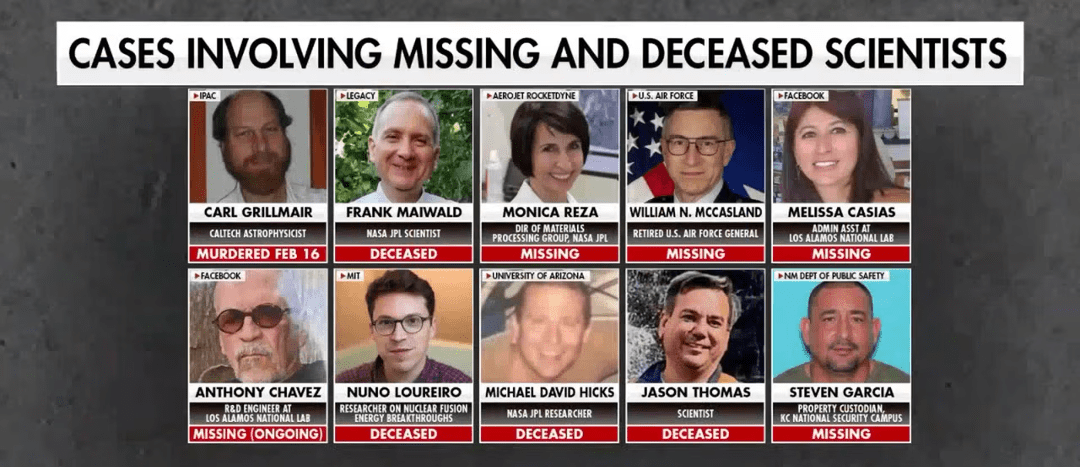
- The individuals were affiliated with institutions such as NASA, Los Alamos National Laboratory, and MIT, with roles tied to nuclear research, advanced propulsion, and classified defense programs.
- The FBI, in coordination with the White House and other federal agencies, is conducting a broad review to identify patterns, shared contacts, travel histories, or potential external threats.
- Incidents span from 2023 through early 2026 and include unexplained deaths, suspected suicides, and disappearances under unusual or unclear circumstances, in some cases involving missing personal effects or incomplete forensic clarity.
- Congressional leaders have requested formal briefings, warning that if the incidents are connected, they could represent a significant counterintelligence or national security issue.
Assessment:
At present, the incidents are assessed as unconfirmed but plausibly interconnected. The concentration of cases among personnel with access to highly sensitive research introduces a credible risk that at least a subset of these events may share underlying drivers. Potential explanations range across a spectrum: coincidence within a specialized professional cohort; insider risk or personal factors; criminal targeting; or more concerningly, foreign intelligence activity seeking to exploit or disrupt US scientific and defense capabilities. While evidence remains insufficient to confirm coordination, the pattern merits sustained investigative focus given the strategic value of the individuals involved.
- Michael David Hicks
A veteran research scientist at NASA’s Jet Propulsion Laboratory (JPL), Hicks worked on asteroid and planetary defense missions including DART; he died in 2023 with no publicly disclosed cause. - Monica Jacinto Reza
A senior aerospace engineer and director of materials processing at NASA JPL, Reza specialized in advanced rocket materials and disappeared while hiking in California in 2025. - Frank Maiwald
A principal researcher at NASA JPL involved in advanced Earth-observation instrumentation, Maiwald died in 2024 under undisclosed circumstances. - Carl Grillmair
A renowned astrophysicist at Caltech’s Infrared Processing and Analysis Center, known for work on dark matter and galactic structures, he was fatally shot in 2026. - Nuno Loureiro
Director of MIT’s Plasma Science and Fusion Center and a leading fusion physicist, Loureiro was killed in a shooting at his home in 2025. - Jason Thomas
A pharmaceutical researcher (Novartis) specializing in chemical biology and complex systems, Thomas disappeared in 2025 and was later found deceased in 2026. - Steven Garcia
A government contractor at a U.S. nuclear weapons component facility (Kansas City National Security Campus), Garcia vanished in 2025 under unclear circumstances. - Anthony Chavez
A former Los Alamos National Laboratory technician with potential exposure to sensitive research, Chavez disappeared in New Mexico in 2025. - Melissa Casias
A Los Alamos National Laboratory administrative employee reportedly holding high-level clearance; she vanished from her home with personal devices wiped. - William “Neil” McCasland
A retired U.S. Air Force Major General and former commander of the Air Force Research Laboratory, McCasland oversaw classified aerospace programs and disappeared in 2026. - Amy Eskridge(often included in extended reporting)
A researcher focused on advanced propulsion and unconventional aerospace concepts; Eskridge died in 2022 under circumstances some reports describe as contested.
Outlook:
The investigation is likely to expand in scope, with increased emphasis on counterintelligence analysis, digital forensics, and interagency coordination. In the near term, expect heightened security measures across sensitive research institutions, including enhanced personnel vetting, monitoring, and protective protocols. Should a definitive link, particularly involving foreign actors, be identified, the situation could rapidly escalate into a high-priority national security issue with implications for research security, workforce protection, and broader geopolitical tensions.
Impact Analysis
The reported cluster of at least 10–11 deaths and disappearances among scientists and officials tied to sensitive US nuclear, aerospace, and defense programs is now drawing formal FBI scrutiny, alongside requests for information from the House Oversight Committee to DOE, NASA, and other agencies. Officials have not confirmed a link among the cases, but the fact pattern has escalated from online speculation to a recognized federal counterintelligence concern.
From an intelligence perspective, the main impact is not yet proof of a coordinated campaign, but the strategic uncertainty created by the possibility that some cases could be related. Even absent confirmation, this kind of cluster can degrade workforce confidence, increase fear among personnel with access to classified or export-controlled work, and force security organizations to divert resources toward protective reviews, insider-risk screening, and case correlation across agencies. The Oversight Committee has publicly framed the matter as a potential “grave threat,” while federal investigators are reportedly reviewing whether any shared patterns, external actors, or foreign intelligence angles exist.
If even a subset of these incidents proves connected, the implications would be significant. A confirmed nexus could indicate hostile intelligence collection, coercion, sabotage, targeting of key personnel, or exploitation of security gaps around highly specialized researchers. That would elevate the issue from a tragic cluster of cases to a broader research-security and national-security problem, with likely second-order effects including tighter access controls, expanded monitoring, travel restrictions, and heightened scrutiny of foreign contacts and anomalous behavior around sensitive programs.
There is also a reputational and operational impact right now, regardless of the final investigative outcome. Public attention, congressional pressure, and fragmented media reporting can amplify speculation, complicate recruitment and retention, and create an environment in which rumor outruns evidence. That dynamic can itself become a security vulnerability by increasing stress, discouraging reporting, or pushing institutions into reactive rather than disciplined risk management. At the same time, at least one former senior nuclear official has publicly cautioned that the cases may ultimately prove unrelated, which remains a plausible outcome and should temper analytic overreach.
Recommended Course of Action
The recommended posture is treat as potentially related until disproven but avoid assuming coordination without evidence. In practice, that means standing up a centralized interagency analytic cell or fusion effort to map timelines, affiliations, access levels, foreign travel, digital activity, known threats, and unexplained commonalities across all cases. The current FBI review and congressional requests suggest that this kind of consolidation is already warranted.
Security leaders at affected agencies and contractors should immediately conduct a targeted protective review of personnel in sensitive programs. Priority actions should include refreshing threat reporting channels, reviewing recent anomalous contacts or approaches, validating employee emergency-contact and wellness protocols, and auditing travel, badge, cyber, and device logs for unresolved anomalies. The goal is not broad panic, but disciplined detection of weak signals that may only become visible when viewed across cases.
Institutions with personnel tied to nuclear, aerospace, advanced propulsion, or classified research should also implement a quiet hardening package: reinforce counterintelligence briefings, tighten need-to-know enforcement, re-verify offboarding and retirement procedures for recently separated staff, and ensure missing-person, death-notification, and suspicious-incident escalation protocols are current and interoperable with federal investigators. Given the public attention around these cases, leadership should pair this with a controlled internal communication strategy that acknowledges concern, states clearly that no confirmed common cause has been established and encourages reporting rather than speculation.
Analytically, the best near-term approach is to work through three parallel hypotheses: first, that the cases are largely coincidental; second, that a subset is linked by non-state criminal or personal factors; and third, that at least some are connected through hostile foreign intelligence or another organized threat actor. Running those hypotheses in parallel reduces the risk of mirror-imaging or prematurely locking into a single narrative.
Bottom line: this should be treated as a high-priority protective intelligence and counterintelligence review, not because coordination has been proven, but because the consequences of missing a real pattern would be severe. The right response is disciplined correlation, quiet hardening, and measured communication.
About RMS International
The world is unpredictable. Your security shouldn’t be. Founded in 2012, RMS International delivers discreet executive protection, intelligence, cyber security, and global travel risk management. From our Risk Operations Center in West Palm Beach, Florida, our analysts maintain continuous global overwatch—tracking emerging threats and safeguarding operations across five continents.
RMS International — peace of mind in a chaotic world.
#MissingScientists #UnresolvedCases #IntelligenceBrief #NationalSecurity #Counterintelligence #EmergingThreats #RiskAnalysis #GlobalSecurity #DefenseSector #AerospaceSecurity #NuclearSecurity #ForeignInfluence #InsiderThreat #ProtectiveIntelligence #RiskManagement #SecurityTrends #Geopolitics #ThreatAssessment #SituationalAwareness #RMSInternational