
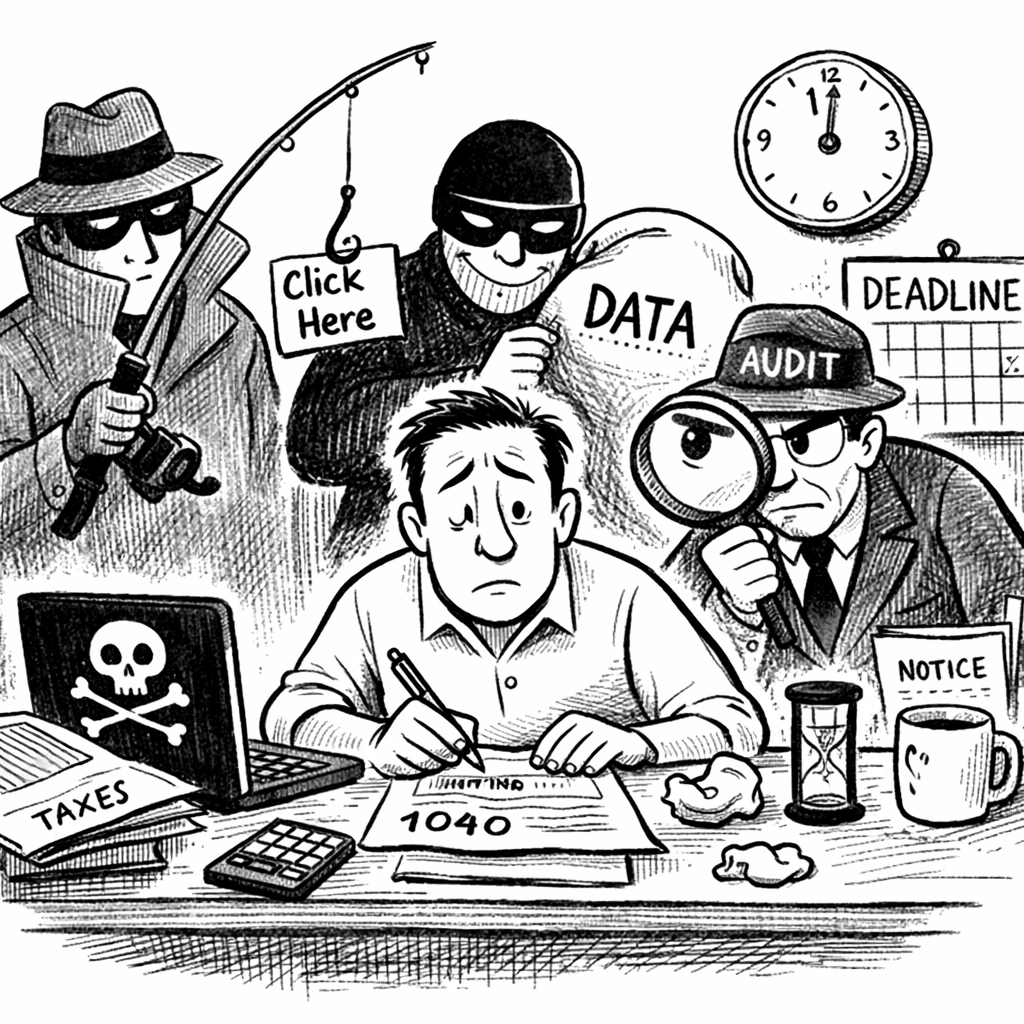
There is a particular stillness that settles in each spring, not the pastoral quiet of thawing earth, but a more bureaucratic hush, punctuated by the soft tapping of keys and the low hum of calculation. It is tax season, that annual ritual in which millions of Americans attempt to translate the messy facts of their lives into the clean geometry of forms. The process presents itself as routine, even mundane. But beneath its orderly surface lies a landscape of quiet risk, technical, psychological, and increasingly, digital.
The modern tax return is no longer a simple ledger of income and obligation; it is a dense packet of identity. Names, addresses, Social Security numbers, banking details, employment histories, each line item, in isolation, is unremarkable. Together, they form a remarkably complete portrait of a person. To file a return today is to consolidate one’s most sensitive data into a single, transferable file. That file moves, through software platforms, cloud servers, preparers, and sometimes, unfortunately, unauthorized hands. The act itself is not inherently dangerous, but it has become a moment of concentration, a point at which risk gathers.
Much of this risk is invisible to the filer. Consider the quiet proliferation of digital intermediaries. Tax preparation, once a largely paper-bound affair, now flows through a constellation of platforms and services, each offering convenience, speed, and reassurance. Yet each additional layer introduces its own vulnerabilities. A compromised account, a reused password, a phishing email dressed in the language of urgency, these are not exotic threats, but ordinary ones, repeated at scale. The attacker does not need to understand the intricacies of the tax code; only the habits of the person filing it.
There is also the matter of timing. Tax season compresses decision-making into a narrow window, encouraging haste. Deadlines, extensions, last-minute document hunts—these create conditions in which scrutiny softens. It is during these moments that mistakes are made: a digit transposed in a routing number, an attachment sent to the wrong address, a link clicked without full consideration. In most cases, the consequence is inconvenience. In some, it is far more enduring. Financial fraud tied to tax filings often begins not with a dramatic breach, but with a small, overlooked lapse.
Even when the process proceeds without incident, the return itself can introduce a different category of risk: error. The tax code is famously complex, and while software has rendered much of it navigable, it has not eliminated the possibility of misinterpretation. A deduction misunderstood, a credit misapplied, a classification entered incorrectly—these can trigger audits, penalties, or delayed refunds. The system, for all its digitization, still depends on human inputs, and those inputs remain fallible.
What is striking is how ordinary all of this feels. Filing taxes does not carry the visible drama of other financial decisions. It is not framed as a negotiation or a gamble. It is framed as compliance. And yet, in its quiet way, it requires a level of diligence comparable to either. The prudent filer is not merely accurate, but attentive: verifying sources, securing accounts, resisting urgency, and recognizing that convenience often arrives accompanied by tradeoffs.
None of this is to suggest that the process is to be feared, or even avoided. It is, after all, a civic obligation. But it is worth understanding that the act of filing a tax return—so often reduced to a checklist item—has become a convergence point for several forms of modern risk. It is a moment when personal data is concentrated, when systems are stressed by volume, and when individuals are asked to move quickly through complex terrain.
The forms themselves remain deceptively simple. Boxes, lines, instructions. But the world around them has changed. And in that shift, the risks have not announced themselves loudly. They have settled in quietly, waiting, like the season itself, for attention.
About RMS International
The world is unpredictable. Your security shouldn’t be. Founded in 2012, RMS International delivers discreet executive protection, intelligence, cyber security, and global travel risk management. From our Risk Operations Center in West Palm Beach, Florida, our analysts maintain continuous global overwatch—tracking emerging threats and safeguarding operations across five continents.
RMS International — peace of mind in a chaotic world.
#TaxSeason #TaxFiling #CyberSecurity #IdentityTheft #DataPrivacy #FinancialSecurity #FraudPrevention #RiskManagement #DigitalSafety #PersonalFinance #TaxTips #StaySecure #AuditRisk #PhishingScams #InfoSec