
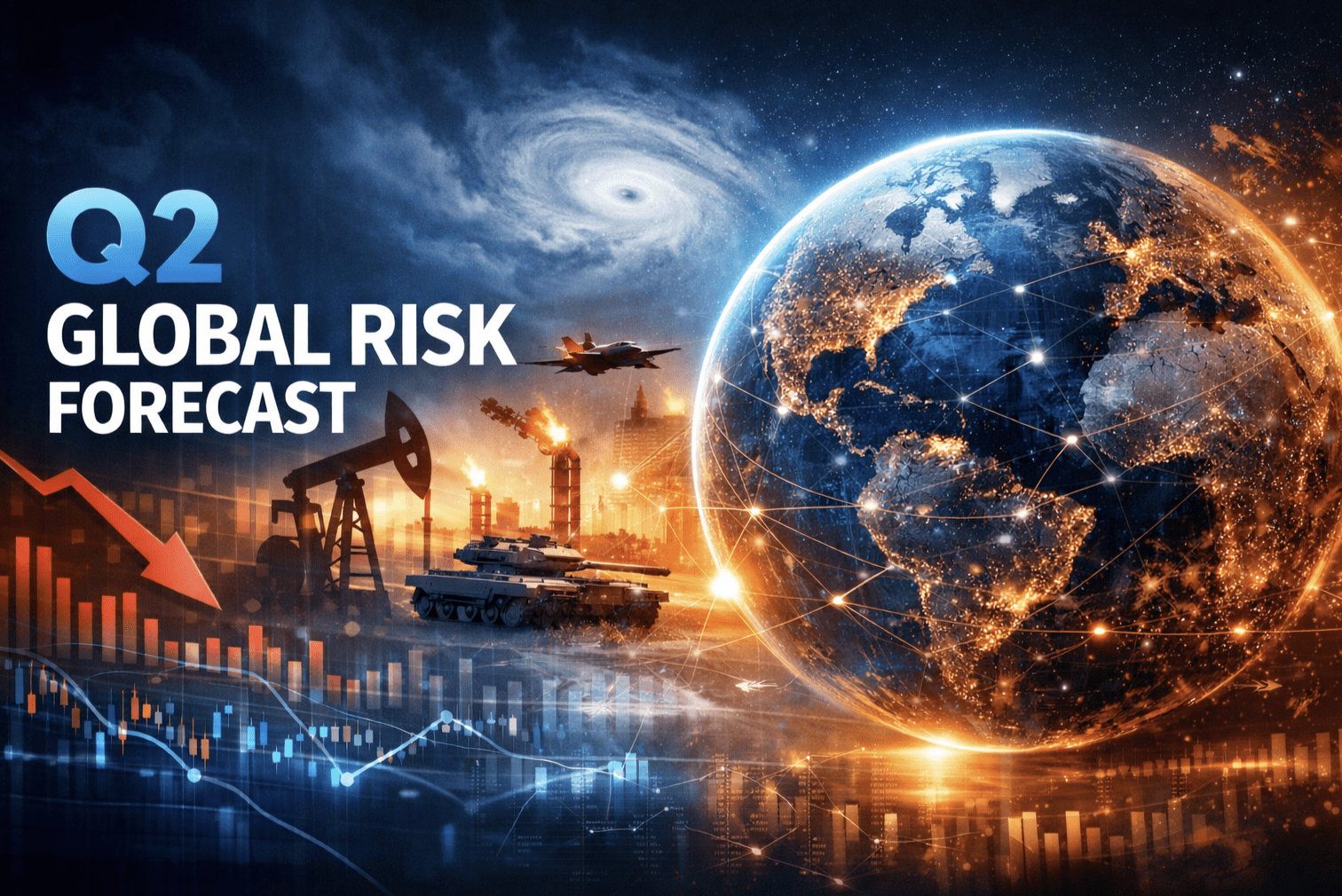
Executive Summary: Q2 2026 will be characterized not by a single defining crisis, but by the convergence of multiple, interdependent pressures across geopolitical, cyber, and environmental domains. Escalating tensions around critical maritime chokepoints, particularly the Strait of Hormuz, are driving sustained volatility in global energy markets and supply chains, while the war in Ukraine continues to shift toward systemic disruption, increasing the likelihood of retaliatory cyber operations targeting Western financial institutions and insurers. Simultaneously, cyber risk is evolving into a persistent, ecosystem-wide threat, with recent breaches and ransomware incidents demonstrating how vulnerabilities within third-party vendors can cascade across entire sectors. Natural disasters, such as seismic activity in the Indo-Pacific, and the proliferation of advanced technologies like drones in unstable regions, further compound this risk environment. Additionally, the growing operational reliance on space-based infrastructure introduces a new layer of systemic exposure. Collectively, these dynamics underscore a tightly coupled global system where disruptions are increasingly overlapping and mutually reinforcing. For insurers and risk managers, the priority shifts from anticipating isolated events to managing cumulative, cascading risks, making resilience, adaptability, and forward-looking intelligence critical to navigating the quarter ahead. |
There are quarters in global affairs that pass with the quiet hum of continuity, and then there are those that seem to vibrate, subtly at first, then all at once, with the friction of systems under strain. Q2 2026 will not announce itself with a singular shock, but rather with the accumulation of pressures: maritime chokepoints narrowing, digital borders dissolving, and the once-reliable distinctions between war and peace, state and proxy, infrastructure and target, becoming increasingly difficult to maintain.
At sea, the world’s most consequential geography remains deceptively small. The Strait of Hormuz, barely twenty-one miles across at its narrowest, has become less of a passage and more of a pressure point. The ongoing conflict involving Iran has transformed commercial shipping into a form of calculated risk, where each transit carries not only commercial goods, but the weight of global inflation expectations. Coalition discussions to secure maritime passage suggest both urgency and hesitation; no nation wishes to own the escalation, yet all are exposed to its consequences. Energy markets, already taut, will continue to transmit volatility outward into transportation costs, into supply chains, and into the quiet mathematics of global continuity of operations.
On land, the war in Ukraine has entered a phase that feels less like stalemate and more like erosion. Ukrainian strikes on Russian defense-industrial sites signal a shift toward systemic degradation rather than territorial gain. These attacks are not designed to redraw maps, but to thin the sinews of war itself. Yet such strategy invites reciprocity, and the most likely domain of retaliation lies not in tanks or trenches, but in code. Western financial institutions, insurers among them, remain exposed to a form of conflict that arrives without warning and leaves no crater, only corrupted systems, interrupted operations, and the slow, expensive work of restoration.
The cyber domain, in fact, has matured into something more ambient than episodic. The recent breach of a federal surveillance system, alongside a large-scale ransomware attack affecting hundreds of financial institutions through a single vendor, underscores a truth that is no longer novel but still insufficiently absorbed: the perimeter has dissolved. Risk no longer resides at the edges of an organization but within its dependencies, vendors, platforms, and invisible chains of trust. Q2 will likely see continued exploitation of these relationships, where a single compromise propagates across sectors with a speed and opacity that challenge both response and attribution.
Meanwhile, the atmosphere, literal and geopolitical, offers its own reminders of instability. A significant earthquake off Indonesia’s coast serves as a periodic punctuation mark in a region defined by tectonic inevitability. Such events, while localized in impact, reverberate through global markets, subtly tightening capacity and recalibrating the cost of catastrophe elsewhere. Climate, in this sense, operates as both an event and multiplier.
In quieter corners of the map, risk accumulates less visibly but no less meaningfully. The reported acquisition of advanced drone systems by forces in eastern Libya suggests that the technologies once monopolized by states are continuing their migration into fragmented environments. These systems, precise and deniable, expand the geography of threat, from battlefields to pipelines, from military bases to commercial vessels. The implication is not immediate disruption, but persistent possibility.
And then there is space, which has re-entered the strategic imagination not as a frontier, but as infrastructure. The successful Artemis II mission, orbiting the Moon without landing, is emblematic of a broader shift: space is no longer aspirational, it is operational. As reliance on satellite networks deepens, so too does the systemic risk associated with their disruption. The sky, once a buffer, is becoming another domain of dependency.
Taken together, Q2 2026 will be defined less by singular crises than by their convergence. Energy insecurity feeds inflation; inflation shapes political stability; political instability invites both physical and cyber disruption. The throughline is interdependence, systems so tightly coupled that stress in one domain is quickly felt in another.
For insurers and risk managers, the challenge is not simply to track these developments, but to recognize their cumulative effect. The question is no longer whether a disruption will occur, but how many will overlap, and in what sequence. In this environment, resilience is not a static condition but a practiced one—measured not by the absence of disruption, but by the ability to absorb it without collapse.
If there is a defining characteristic of the quarter ahead, it is this: the world is not unraveling, but it is tightening. And in that tightening, the margin for error grows thinner, the cost of miscalculation higher, and the importance of foresight, quiet, disciplined, and unglamorous, more essential than ever.
About RMS International
The world is unpredictable. Your security shouldn’t be. Founded in 2012, RMS International delivers discreet executive protection, intelligence, cyber security, and global travel risk management. From our Risk Operations Center in West Palm Beach, Florida, our analysts maintain continuous global overwatch—tracking emerging threats and safeguarding operations across five continents.
RMS International — peace of mind in a chaotic world.
#GlobalRisk #Q22026 #RiskForecast #Geopolitics #CyberRisk #SupplyChainRisk #MaritimeSecurity #StraitOfHormuz #EnergySecurity #HybridThreats #CriticalInfrastructure #ThirdPartyRisk #Ransomware #SystemicRisk #ClimateRisk #NaturalDisasters #DroneWarfare #EmergingTech #SpaceInfrastructure #Resilience #RiskManagement #InsuranceRisk #OperationalResilience #GlobalSecurity #ThreatIntelligence