
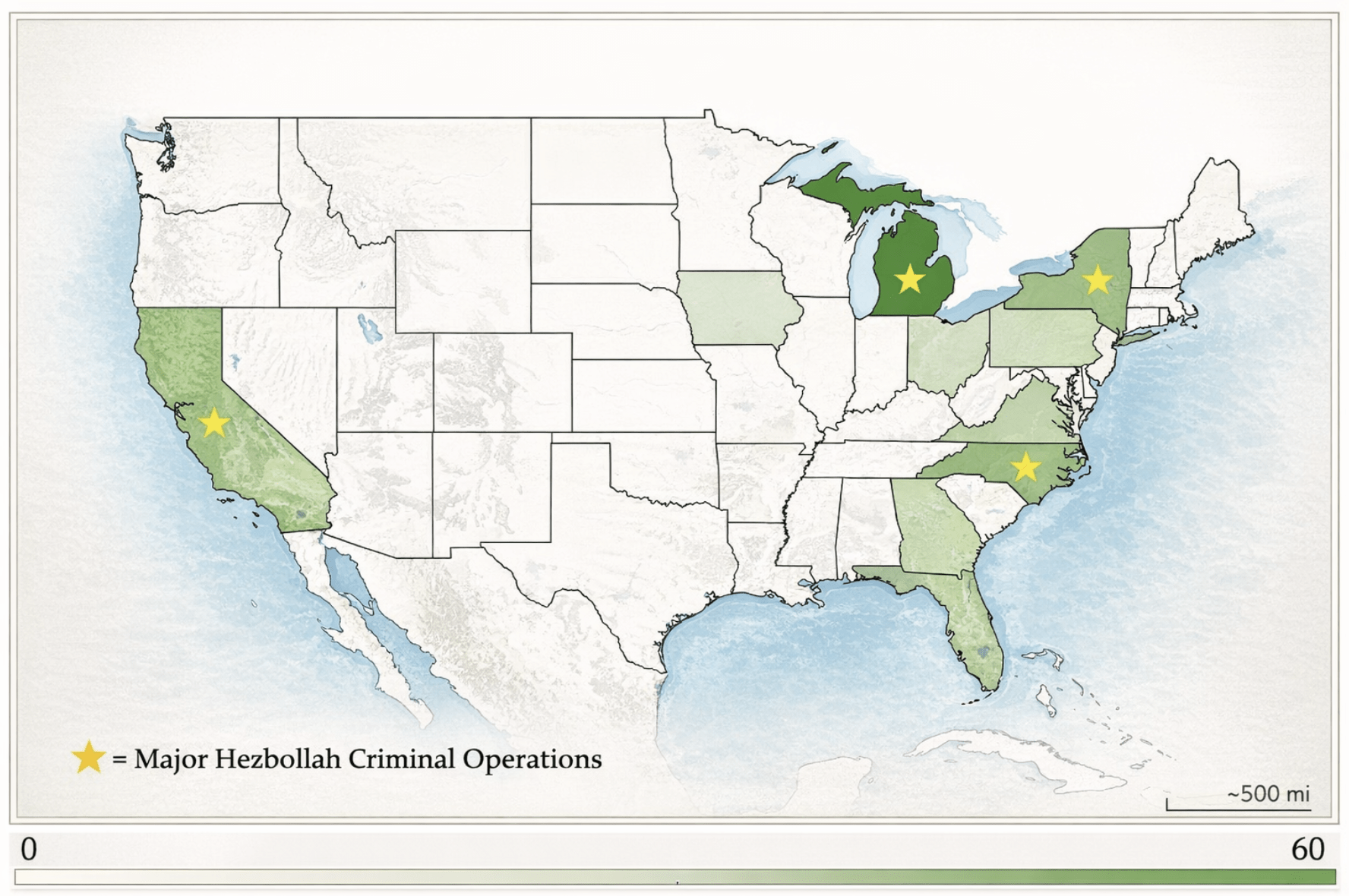
Map taken by 2022’s journal article “Hezbollah’s Operations and Networks in the United States: Two Decades in Review.”
Persian Pressure: Tehran’s Option for Payback
For years, Iran’s preferred instrument has not been the clean declaration but the blurred edge: pressure applied through proxies, deniable cyber units, intelligence cutouts, and partners who can wound without quite signing their names. US official assessments still describe Tehran as a serious threat actor, noting both its support to the “Axis of Resistance” and its willingness to conduct aggressive cyber operations against US and allied networks. The same assessments also say Iran’s leadership has generally sought to avoid a full direct war with the United States, which makes the shadow campaign, the hack, the harassment plot, and the outsourced strike, the more plausible method of retaliation.
That retaliation could arrive first through keyboards. In recent US warnings, CISA, the FBI, NSA, and partner agencies urged organizations to stay alert for Iranian-affiliated targeting of critical infrastructure and key resources (CIKR), as well as other US entities. That matters because cyber retaliation is cheap, scalable, and theatrically useful: a disruptive intrusion into a municipal network, a destructive hit on a poorly secured industrial system, a ransomware-style operation with political overtones, or a leak designed less to steal money than to produce anxiety. Iran does not need to darken an entire grid to succeed; it only needs to prove that distance is not protection. Physical retaliation, meanwhile, would more likely follow the established architecture of proxies and surrogates than some cinematic amphibious landing on the American coast. The FBI publicly describes the Iranian threat as spanning terrorism, foreign intelligence, kidnappings, cyber activity, and lethal targeting of dissidents and officials; ODNI likewise points to Iran’s use of militant partners across the region. In practice, that means the credible concern is not just a bomb or a shooting, but surveillance, intimidation, attempted assassination, attacks on symbolic sites, or violence directed at Israeli, Jewish, diplomatic, or government-linked targets by actors inspired, enabled, or tasked from afar.
And then there is the phrase that hovers over every anxious argument about homeland security: sleeper cells. It is a phrase that does a great deal of emotional work in American politics because it converts uncertainty into a story. Border encounters surged during parts of 2020–2024, and official reporting notes shifts in migration routes through the hemisphere. US threat assessments warn extensively about terrorism, transnational crime, cyber risk, and hostile state activity; however, it is possible Iranian sleeper cells or their allies entered undetected through the “open” southern border.
The more durable lesson is that retaliation, if it comes, may not look like revenge in the blunt, historical sense. It may look like interference, sabotage, coercion, and fear distributed across systems that are already stressed: hospitals, utilities, transportation nodes, houses of worship, corporate networks, public officials, diaspora communities. States such as Iran rarely need to strike everywhere. They need only remind a larger, richer adversary that modern power is full of exposed surfaces, and that in an age of proxies and packets, the homeland is not a place beyond the map.
About RMS International
The world is unpredictable. Your security shouldn’t be. Founded in 2012, RMS International delivers discreet executive protection, intelligence, cyber security, and global travel risk management. From our Risk Operations Center in West Palm Beach, Florida, our analysts maintain continuous global overwatch—tracking emerging threats and safeguarding operations across five continents.
RMS International — peace of mind in a chaotic world.
#Iran #IranThreat #AxisOfResistance #MiddleEastSecurity #Geopolitics #NationalSecurity #HomelandSecurity #StrategicThreats #CyberSecurity #CyberWarfare #CriticalInfrastructure #CIKR #CyberThreats #CyberDefense #InformationSecurity #OperationalTechnology #ICSsecurity #Counterterrorism #ThreatAssessment #IntelligenceAnalysis #SecurityIntelligence #RiskIntelligence #ProtectiveIntelligence #NationalThreats #HybridWarfare #ProxyWarfare #GreyZoneConflict #StateSponsoredThreats #IrregularWarfare #AsymmetricWarfare #HomelandDefense #InfrastructureProtection #TerrorismThreat #SleeperCells #BorderSecurity #TransnationalThreats #SecurityStudies #RiskManagement #GlobalSecurity #StrategicRisk #SecurityPolicy